
When shopping for internet service, you should know about the new broadband labeling requirements. The FCC now requires ISPs to clearly state speeds, pricing and other critical details about their services. These new Broadband Consumer Labels look like the FDA’s nutrition labels. Overall, the government is trying to make ISPs present their offerings in a standard and less confusing way.
Examples
Here’s an example of what you will find, when you go shopping at Xfinity’s website:

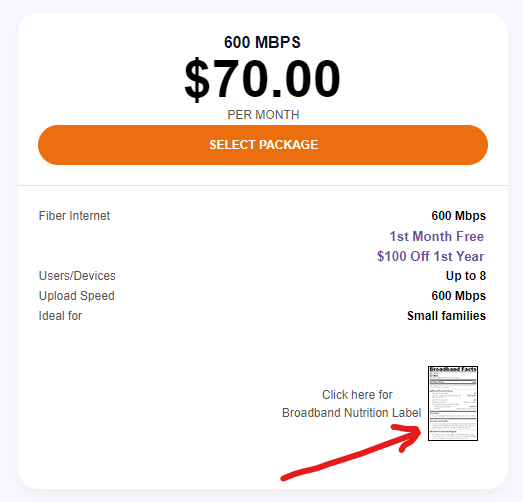
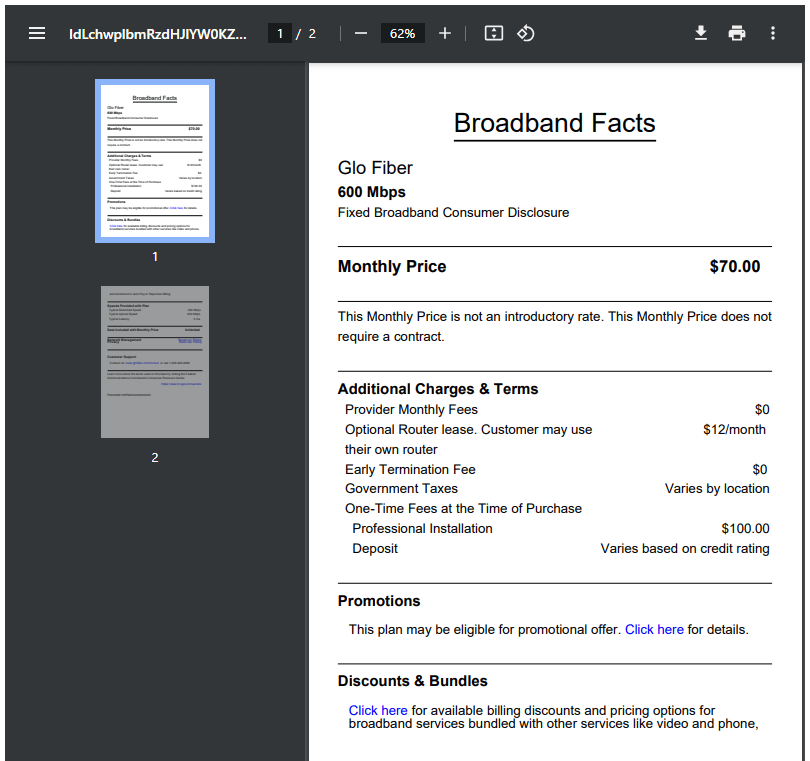
When I visited the Glofiber page, their internet offerings were super-clear with these labels:
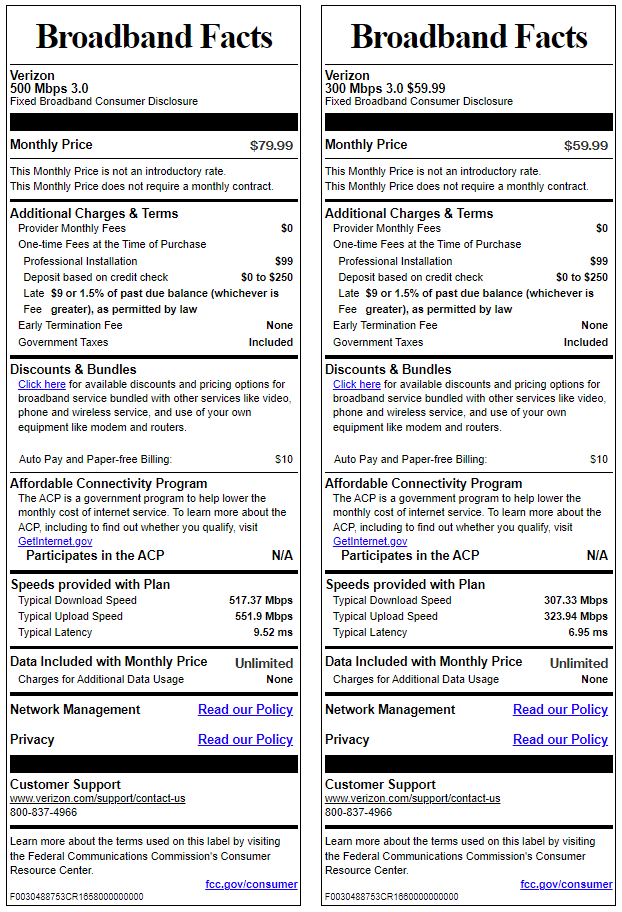
Despite this being a strict federal requirement, some ISPs are going to play with the format, to see what they can get away with. I went shopping for Verizon Fios, and didn’t see these labels. They gave me the same old Plan Summaries and encouraged me to choose one. But below these choices was a small, plain link that said “Jump to broadband facts labels” and those revealed the clearer details:
If you cannot locate these Broadband Nutrition labels on an ISP’s website, please know that:
- This is a new requirement, and they may still be working to update their website.
- Small ISPs (with fewer than 100,000 subscribers) have until October to comply.
- The FCC would like for you to let them know, if an ISP is not posting these labels, or if they are being inaccurate with their pricing or other stated details. You may report such deceptive business practices at this site.
Importance of Broadband Labels
These labels are meant to help you avoid unpleasant surprises on your internet bill. So many people sign up with an ISP due to a low monthly price, only to find out a year later that they were enjoying a promotional discount. When the real price kicks in, those customers feel duped or taken advantage of. The FCC intends for these labels to help you know when you are paying a reliable price or a temporary one.
Besides clearing the air over pricing, these labels may help you understand your internet speed. It is so important to know what speed you should be getting in your home! Let me digress with this scenario:
I frequently help clients in speeding up their tech and figuring out why things are slow. And in the course of this detective work, I have to ask them: What speed of internet are you paying for? Many people do not know the answer to this, so we look at their internet bill. If we can’t find the speed on the bill, we visit the ISP’s website. And even then, we may not find any speed numbers. How in the world are we to know if their internet is operating correctly, if we can’t determine what speed they should be seeing?
These labels will clear up that kind of mess. Customers will be able to run a simple speed test, compare it against their broadband label, and reach out to the ISP over any discrepancy. Not that I don’t enjoy the detective work, but this will save everyone so much time!
2026 Update
I am sad to report that I’ve encountered ISP manipulation of these Broadband Consumer Labels. Let me describe my scenario…
I am a Verizon Fios customer. I sign in to their website to review my account and see that I am paying for their 300M fiber internet, and nothing else. When I click through to the Broadband Consumer Label for my plan, I see:
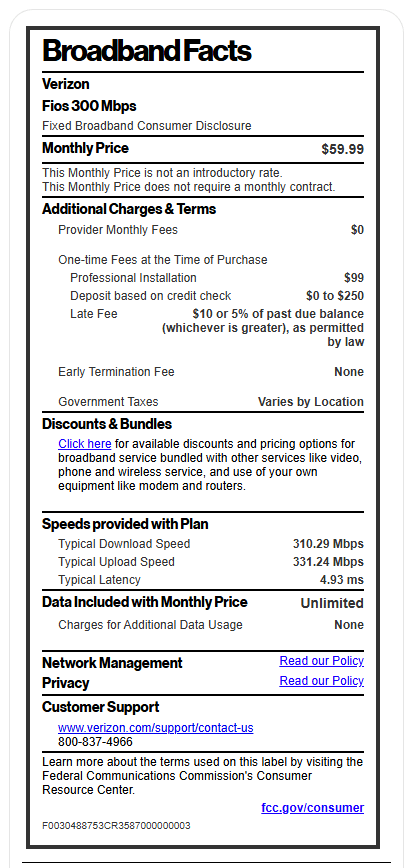
Since I’m logged in to my account, I should be able to trust that disclosure when I pull it up on the Verizon website, right? I should have confidence that $59.99 is the standard monthly price for the 300M plan? As it turns out, it isn’t.
I logged out of the Verizon website and went “shopping”. Posing as a new customer, I input my address to see what Verizon would offer me, as a person looking to relocate (to my current address). It was very easy to arrive at all of the internet speed and price options, and I went right to my 300M plan to review its Broadband Consumer Label:
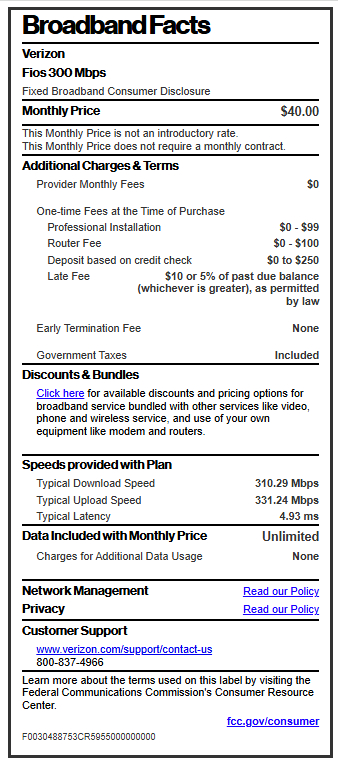
$40/mo is the price for 300M fiber internet at my house, according to that label. That’s a $20/mo difference. If I hadn’t maintained my healthy mistrust of ISPs, I might’ve never caught this, and Verizon would’ve made an extra $240/yr off of me.
I contacted Verizon and they corrected my billing promptly enough. But they made no effort to explain the discrepancy in labels. I was left to imagine how many other people are in the same situation as me, but not knowing to investigate the website as I did. How many other people are going to pay Verizon hundreds of dollars extra this year for their internet service?
I did report this matter, both to the FTC and the FCC. But I can’t say I have much faith in the process. Both entities accepted my reports and gave me the boilerplate message: “Your report has been forwarded to the ISP, and they have a month to respond to you.” I did not get the impression that there would be any penalty levied on Verizon for their pricing games.